Sunday, January 28, 2007

A Winter's Day


Withering and keen the winter comes
While comfort flyes to close shut rooms
And sees the snow in feathers pass
Winnowing by the window glass...
from 'The Shepherd's Calendar' John Clare


But Winter hasn't really come, or at least it paid a fleeting visit last Monday but declined to stay.


I took these pictures of snow over Ambleside, just to prove to myself that we have managed a couple of wintry days, so far.

Wednesday, January 17, 2007

Off by heart


Scenes from Boarding School Life - 4


Is this a dagger which I see before me,
The handle toward my hand? Come let me clutch thee:
I have thee not, and yet I see thee still.
Art thou not, fatal vision, sensible
To feeling as to sight? or art thou but
A dagger of the mind, a false creation,
Proceeding from the heat-oppressed brain?
I see thee yet in form as palpable
As this which now I draw


At school we had a system of black-marks (called ‘untidies’) which were meted out by senior girls who inspected common-rooms and cloakrooms daily just before tea. At the end of tea a senior would read out the list of miscreants - and their misdemeanours: a scarf left on the cloakroom floor, a writing-case left on the common-room table, a hockey-boot - not put away in a cloakroom locker.


These were to be reported to Group-leaders next lunchtime. (we had Groups rather than Houses - they had the embarrassingly twee names, Balmoral, Buckingham, Sandringham and Windsor.)

I usually managed two or three Untidies each term.


Oh dear, yet another. I mounted the stairs to the mezzanine where the mysterious pine-clad prefects’ study was, to report to a Buckingham Group Leader - we weren’t allowed to ask for specific people; one took pot luck This time I got the severest prefect, Carol M.


‘I’ve come to report an Untidy’ . I stood on the steps, trying to catch a glimpse of the inner sanctum.

‘Again? Which Shakespeare play are you studying in class? Macbeth? Right, bring your book to me after games..


Later I returned with ‘Macbeth’


She leafed through the book.


‘Right. I want you to learn this short passage off by heart. From ‘Is this a dagger…’ to ‘…this which now I draw’. By Wednesday.’


On Wednesday I made my way to the Study. …art thou not fatal vision.. bounded up the stairs ..or art thou but a dagger of the mind…and knocked on the door…the heat-oppressed brain..


I confronted Carol M. and handed her the book, opened at the marked page.
I took a deep breath:


‘IsthisadaggerwhichIseebeforemethehandletowardsmyhandcomeletmeclutchtheeIhavetheenotandyetIseetheestill.’

I closed my eyes to block out any distractions , and carried on, heady with my own success. I could see the end in sight:

‘…orartthoubutadaggerofthemindafalsecreationproceedingfromtheheat-oppressedbrain…proceedingfromtheheat-oppressedbrain….theheat-oppressed brain..’


But nothing more proceeded from my heat-oppressed brain. Nothing. Time seemed to stand still. I hardly knew where I was any more.


‘You may have another day - come back tomorrow.’


My brain melted with gratitude. I almost liked Carol M. now; after all, if she had chosen to she could have given me a completely new passage to learn.


I started down the stairs.


Proceeding from the heat-oppressed brain. I see thee yet in form as palpable as that which now I….I'd got it. I'd got it.


I turned to go back, but the Study door was firmly closed. But I knew that tomorrow I would be OK.


I remember those words 50 years later. And the many other poems and prose passages that I learnt ‘off by heart’ . I enjoy letting those words swim around in my head.


And I am grateful for that civilised ‘punishment’.

Friday, January 12, 2007

Post-Christmas Slump, or 'The cure for this ill'


This is the time of year when I unaccountably slide downwards into a mildly negative mood. Perhaps it is because the (excessive) purposefulness of Christmas preparations has gone, and there is nothing yet to replace it.

This morning was overcast, dull, windy, drizzly and utterly gloomy weather-wise. Could I stand going into town - again? During this nothing-will-please-me-today-no-matter-what mood, the several usually pleasant routes into town all seemed uninviting.


What was needed was Action!


‘The cure for this ill
is not to sit still
Or frowst with a book by the fire;
But to take a large hoe
And a shovel also
And dig till you gently perspire’


(not Kipling’s best - but nevertheless wise advice)


In this weather, digging was not an option, so we decided on a vigorous walk. We drove the 9 miles to Windermere, and parked in the village of Bowness. This is perhaps more a small town than a village and in the Summer it can be as crowded as Blackpool. Nevertheless, its situation reminds me faintly of those little towns on the Swiss lakes - an English spin on Vevey.


Today there were only a few locals and hardy visitors around. We had our coffee and a slice of the best lemon meringue pie in Cumbria at ‘Bowness Kitchen’ then did a circuit of Helm Road and Biskey Howe Road, a loop which takes you up to the Biskey Howe viewpoint - a huge reward for minimal effort. (although it doesn’t feel like that for the first quarter of a mile - it’s a bit of a stagger whichever end of the loop you start from)

A pile of twigs in a garden: Biskey Howe Road. I like the range of winter colours:


And above, a mysterious gate leads - where?


The path up to the viewpoint


The rocky outcrop looks like a mountain range from this angle


The viewpoint summit, with a misty Windermere, looking north towards Ambleside:


The summit looking south, towards Newby Bridge:


We rejoin the road...

... down to the village


And back to Bowness and human company again. And although it was raining by now - that typical Lake District rain which is blown in all directions at once, and an umbrella is a liability - our mood was lifted, the endorphins were released, and the ill most definitely cured!

Sunday, January 07, 2007

Twelfth Night


There is some disagreement as to whether Twelfth Night is the 5th January - the eve of Twelfth Day, or on the 6th January - the evening of the Twelfth Day. Either way it has come and gone.


So, all the Christmas decorations are down; the tree dismantled, the wreath taken from the front door, the cards read once more then placed into the recylcing box. Why is it such a mournful task?
I'm relieved in one way - they all seem so irrelevant once the Day itself is over. But is it sad because perhaps Christmas once again has not quite lived up to expectations? Am I trying in vain to recapture the magic I felt as a child?


Dad took this photo of my sister and I sitting in front of the fire in our basket chairs c.1952, and accidentally superimposed another picture of us singing carols. But the result was rather nice.

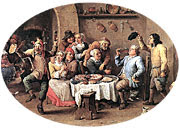
17th Century Twelfth Night merriment.
Now Christmas is past,
Twelfth Night is the last

To the Old Year adieu,
Great joy to the new

Tuesday, January 02, 2007

'On Christmas Day in the Morning'


The weather this Christmas has been unseasonably mild. We still had a few brave roses nodding doubtfully, and little sprigs of campanula poscharskyana still clinging to life in the front tubs.

I lit the fire on Christmas Day, not because we needed it, but just because Christmas without a fire seems all wrong. So we sat round feeling uncomfortably warm!


Francis Kilvert, a young curate lodging at Ashbrook House, Clyro, during the 19th century, was not so lucky.


Rev. Francis Kilvert

This is his diary entry for Christmas Day 1870:


'Sunday, Christmas Day

As I lay awake praying in the early morning I thought I heard a sound of distant bells. It was an intense frost.

I sat down in my bath upon a sheet of thick ice which broke in the middle into large pieces whilst sharp points and jagged edges stuck all round the sides of the tub like chevaux de frise, [spiked defensive structures] not particularly comforting to the naked thighs and loins, for the keen ice cut like broken glass. The ice water stung and scorched like fire. I had to collect the floating pieces of ice and pile them on a chair before I could use the sponge in my hands for it was a mass of ice.

The morning was most brilliant. Walked to the Sunday School with Gibbins and the road sparkled with millions of rainbows, the seven colours gleaming in every glittering point of hoar frost. The Church was very cold in spite of two roaring stove fires.'


Read more about Francis Kilvert and his Diary here: http://www.smr.herefordshire.gov.uk/guest_authors/Francis%20Kilvert

Sunday, December 31, 2006

anno domini 2007

My Christmas - Breughel's Census

Back online! Just in time for the New Year.

Received my new package including a 'livebox' to make our computers wireless. Rather daunting to connect - I could have had it done by my ISP's technician for £65 - but with both my sons home for Christmas, I was saved that expense!

This has been probably our last traditional 'family Christmas' (Mum, Dad & 'the boys') as our eldest is getting married at Easter. So being wirelessly connected 'the boys' (aged 25 & 24) spent most of the time playing a 2-player sci-fi game, 'Red Alert' - one on my desktop and one on my laptop, to the accompaniment of wall-to-wall Simpsons on TV. (Rather touchingly, though, they play these games as a team, both on the same side rather than against each other).
I wonder - if we'd had a daughter, would I get to watch 'Private Life of a Christmas Masterpiece: Breughel's Census at Bethlehem' or perhaps 'Giselle' or 'Cosi fan tutte' ? But, being outnumbered by males 3 to 1, no chance.

So - back to the Blog; but how on earth does one blog? I've forgotten. I was just beginning to get a bit more fluent, and now must start from scratch again. Help!


Their Christmas - 'Red Alert'

Friday, December 01, 2006

Off the Air

Dear Readers,

Sorry, I am Netless at the moment.

My ISP (v21) was taken over by Biscit and for some reason NetServices disconnected all v21 customers without any warning whatsoever!
So now I must wait for NetServices to 'release my MAC' - a migration code without which one cannot sign on with another server!

So - I can only access the net occasionally at my local library.

Hope to resume normal services as soon as possible.

Regards,
anno domini

Saturday, November 11, 2006

11th November


What passing-bells for these who die as cattle?
Only the monstrous anger of the guns.
Only the stuttering rifles' rapid rattle
Can patter out their hasty orisons.
No mockeries for them: no prayers nor bells,
Nor any voice of mourning save the choirs, -
The shrill, demented choirs of wailing shells;
And bugles calling for them from sad shires.


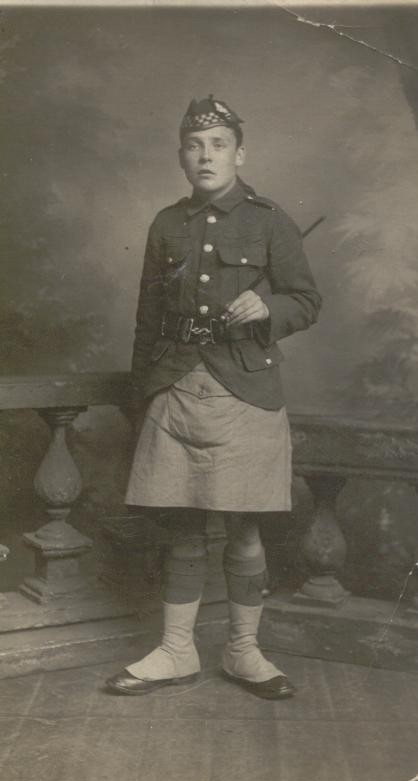
This lad - a neighbour of my grandmother in Carlisle - joined the Argyll & Sutherland Highlanders. He was known in the neigbourhood as ‘Little Isaac’ . He was wounded in 1918, and repatriated. He died, aged 21, on 9th November, two days before the end of the 1st World War.


A couple of days later, my mother, who was a small child at the time, remembers seeing the coffin being passed out of the front ground-floor window of the small terrace house where Isaac’s family lived, en route to his funeral. As this was happening, the church bells rang out to mark the Armistice.


What candles may be held to speed them all?
Not in the hands of boys, but in their eyes
Shall shine the holy glimmers of good-byes,
The pallor of girls’ brows shall be their pall;
Their flowers the tenderness of patient minds,
And each slow dusk a drawing down of blinds.
Anthem for Doomed Youth. Wilfred Owen
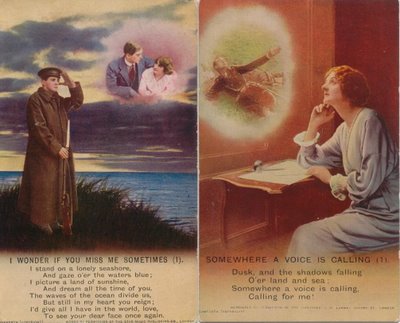


These sentimental postcards were produced during the First World War for soldiers and their girlfriends. (But I suppose they had much to be sentimental about)

Wednesday, November 08, 2006

'Nobody reads my Blog'

No time to blog this week - so I'm cheating a bit:


T-shirt for despairing bloggers from: http://www.jinx.com/scripts/details.asp?affid=-1&productID=483


Mug, cushion and sweatshirt ('Everything you do can and will be used as blog material')


Sunday, November 05, 2006

Gunpowder , Treason & Plot


Remember, remember
the fifth of November -
Gunpowder treason and Plot.
I see no reason
Why gunpowder treason
Should ever be forgot


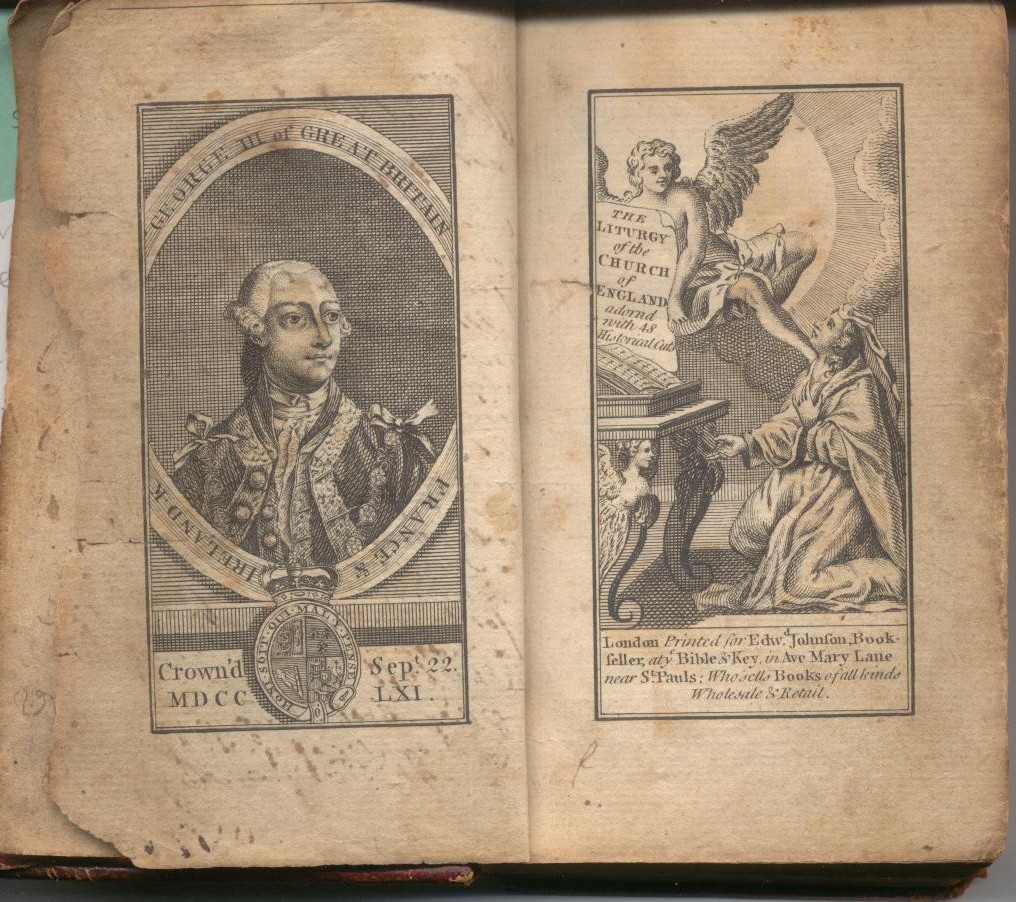
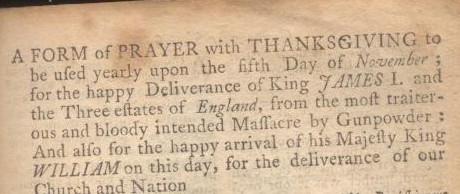
In the early '70s I bought this old prayerbook in a junk shop in Fleet Road, near South End Green, Hampstead. It was printed in Cambridge in 1766 during the reign of George III. (On the endpapers of the book are various handwritten names and snippets from previous owners - but that's another story)


Frontispiece. Book of Common Prayer, 1766


The book includes a form of prayer - long since dropped - to be used on the 5th of November as a thanksgiving for the deliverance of King James from the gunpowder plot.


The service includes this contemporary prayer - strange to think that the sentiments expressed were 'politically correct' at the time!

Almighty God, who hast in all ages shewed thy power and mercy,
in the miraculous and gracious deliverances of thy Church,
and in the protection of righteous and religious Kings and States,
professing thy holy and eternal truth, from the wicked conspiracies, and malicious practices of all the enemies thereof:
We yield thee our unfeigned thanks and praise for the wonderful and mighty deliverance
of our gracious Sovereign King James the First, the Queen,
the Prince, and all the Royal Branches, with the Nobility,
Clergy and Commons of England, then assembled in Parliament,
by Popish treachery appointed as sheep to the slaughter,
in a most barbarous and savage manner,
beyond the examples of former ages....


There is also this prayer thanking God for the arrival of William of Orange in 1688 (also on 5th November):

..God...didst likewise upon this Day wonderfully conduct thy servant King William
and bring him safely unto England , to preserve us from the attempts of our enemies
to bereave us of our Religion and Laws...

It is hard to imagine such prayers being uttered in churches today.


Read about the Gunpowder Plot here:

The Plotters:


The Outcome:
Hanged, drawn & quartered


Saturday, November 04, 2006

Bonfire Night


When I was around 6, we still lived in the town. One Bonfire night, Dad was working late, so on that dark, clear evening Mum and Auntie Gwen lit the fireworks for my sister and I. We oohed and aahed at the pretty showers of Roman Candles, felt the frisson of danger at a ‘Volcano’ and held fizzing sparklers aloft. Bangers were outlawed - we were gentle creatures then - but we agreed to just one Jumping Jack which we watched from a safe distance as it darted about in its random path.


At the bottom of the box lay a rocket. A small benign-looking affair.
‘No, Mum - too scary,’ we chorused.
But, egged on by the giggling Gwen, Mum stood the rocket in a milk bottle and lit the touch paper.
‘Quick, back to the house,’ We retreated to watch from behind the French-window. Swoosh. Silence. Then the crash and tinkle of broken glass.


Lights went on in the bedroom of the H’s house that our garden backed on to, and we could see the jagged hole in one of the panes.


‘Right - shut the window,’ Mum gasped, ‘Put the lights out.’


Hands to mouths, we stood shivering in the dark. We waited for the Knock on the Door.
When it came, Mum snapped back into Sensible Grown-up Mode. Patting her hair and straightening her dress, she put on a brave face and switching on the hall light, went to answer the door.


The next day Dad arranged for a glazier to fix the H’s window and neighbourly harmony was restored.


But I had learnt something about grown-ups.: Mum had been as scared as a naughty child. And for a moment had been prepared to take the ‘dishonest’ path, and to pretend that it was not our fault.


I’m glad she thought better of it!

Wednesday, November 01, 2006

When the Saints go marching in

Hard on the heels of All Hallows’ Eve comes All Saints’ Day
We have some interesting, though fairly obscure, British saints.


Here are the fun bits of a few of them:


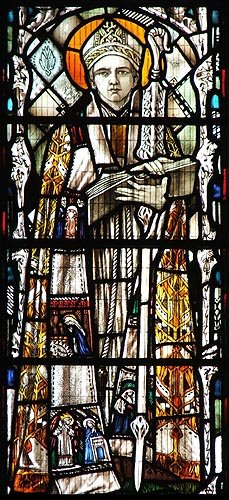
St. Kentigern - the patron saint of the church in my home village. He is known in Scotland as Mungo . Kentigern’s mother was Tenew, an unmarried Scottish woman who is said to have had an affair with her cousin. The penalty for such behaviour (only for the woman, of course!) was that she be flung off a nearby hill. Somehow, the poor lady survived the fall, and she was then cast adrift in a coracle - an almost circular primitive little boat - which floated off and landed at Culross. Here a saintly monk, Serf, found her and took care of her and of her baby son. The boy was educated by Serf, and became a religious leader himself, and later a Bishop. He travelled around Scotland, Cumbria (Northern England) and to Wales.
A fuller version of the life of Kentigern/Mungo is here:
http://dspace.dial.pipex.com/town/plaza/aaj50/mungo.htm
St. Kentigern’s church in my home village in Cumbria can be seen here:
http://www.visitcumbria.com/churches/irthington.htm


St. Swithun (or Swithin)

Swithun became Bishop of Winchester in 852 AD. He built many churches and when he died he was buried at Winchester. Later his body was removed to a more splendid golden shrine in the cathedral; this move, on 15th July, was delayed by inclement weather, so arose the weather rhyme that the weather on the festival would prevail for 40 days:

"St. Swithun's day, if thou dost rain,
For forty days it will remain;
St. Swithun's day, if thou be fair,
For forty days 'twill rain na mair."

More about Swithun here:
http://www.earlybritishkingdoms.com/adversaries/bios/swithun.html


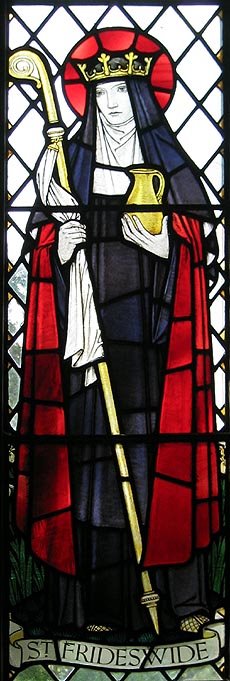
St. Frideswide (c.665-735) It is thought that Frideswide was born in Oxford.


When she heard that a persistant suitor was planning to carry her off, Frideswide who had by now made a vow of celibacy, fled to the river Thames where she found a boat. She drifted to a ’place of controversial location’ (thought to be Bampton or Frilsham). There she lived in a deserted pig-stye. Through her prayers, a fountain sprang up providing her with the means to live undetected in the forest for several years.
More here:
http://www.berkshirehistory.com/bios/frideswide.html


There are many many more less well-known British saints - a surprisingly full list is to be found here: http://www.britannia.com/bios/saints/