Wednesday, April 25, 2007

An Unforgettable Day


My elder son was married on Easter Day in the Chapel of Trinity College, Cambridge. The weather was kind to us. For the previous week it had been chilly in Cumbria, and I was concerned about the female participants in flimsy summer outfits: I needn't have worried - the sun shone all day. Here are a few photos:


Man and Wife

Leaving the Chapel
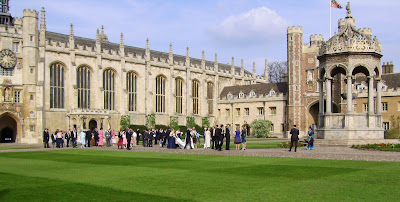
Young guests playing 'tag' around the Great Court Fountain (taken from the Hall)

Bride and Groom at the Wedding Breakfast in the 17th Century Great Hall - presided over by Henry VIII (a copy of the Holbein original)
The first dance


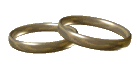
What greater thing is there for two human souls than to feel that they are joined together to strengthen each other in all labour, to minister to each other in all sorrow,to share with each other in all gladness,to be one with each other in the silent unspoken memories?
after George Eliot


A lone bridesmaid wanders across twilit Great Court - the end of a wonderful day!

Thursday, April 19, 2007

Wearing White for Eastertide


Loveliest of trees, the cherry now
Is hung with bloom along the bough,

And stands about the woodland ride
Wearing white for Eastertide,

Now, of my threescore years and ten,
Twenty will not come again,
And take from seventy springs a score,
It only leaves me fifty more.

And since to look at things in bloom
Fifty springs are little room,
About the woodlands I will go
To see the cherry hung with snow.
A.E.Housman


Spring in my Cumbrian garden. Not cherry, but amelanchier - and in a few fleeting days the blossom will be gone; already it is littering the lawn with its confetti.


And under the tree, self-seeding forget-me-nots revel in their profusion.

Wednesday, April 04, 2007

An Easter Story

The Arrest of Christ. Fra Angelico


When they were small, my two sons attended a Church of England primary school, so were familiar with stories from the Bible. One day near Easter, I found them acting out a story they had heard at school. I gathered that it was a scene from the arrest of Jesus in the Garden of Gethsemane, as it involved a lot of jumping on and off the sofa shouting, and waving ‘swords’ (plastic rulers)

I feel the message had been lost somewhere along the line, as after a while I heard the youngest wail,

‘That's it. I'm not going to be Jesus any more’ (He threw down his 'sword')

‘I want to be a goody


Happy Easter!


Friday, March 30, 2007

'Time-honoured Lancaster'


I visited Lancaster today, and came across this horseshoe set into the pavement. It represents the place where John of Gaunt’s horse was said to have shed a shoe.


‘Old John of Gaunt, time-honoured Lancaster’ (opening line of Shakespeare’s ‘Richard II’)


John of Gaunt, Duke of Lancaster (called after his birthplace, Ghent) was born in 1340, and was the third surviving son of King Edward III (He died in 1399)

Although Shakespeare has one of the witches in ‘Macbeth’ telling Banquo, ‘Thou shalt get kings, though thou be none’ - this could just as easily apply to John of Gaunt. His son was Henry 1V, his grandson Henry V and his great-grandson Henry VI. His illegitimate descendants (who became legitimate after his marriage to his former mistress Katherine Swynford) were known as the Beauforts, and one of them, Margaret, married Edmund Tudor; their son became Henry VII - and so the descent carried on, to Henry VIII and beyond!
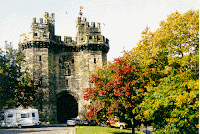
John of Gaunt's Gateway at Lancaster Castle
(pity about the caravan!)


John of Gaunt is fortunate to have these famous words (about his country) put into his mouth by Shakespeare (in ‘Richard II’)

This royal throne of kings, this scepter'd isle,
This earth of majesty, this seat of Mars,
This other Eden, demi-paradise,
This fortress built by Nature for herself
Against infection and the hand of war,
This happy breed of men, this little world,
This precious stone set in the silver sea,
Which serves it in the office of a wall,
Or as a moat defensive to a house,
Against the envy of less happier lands,
This blessed plot, this earth, this realm, this England,


John of Gaunt - at Lancaster Castle


Tuesday, March 20, 2007

Late Winter or Early Spring?

Some photos taken yesterday:


Snow-capped Langdale Pikes above Windermere

Todd Crag from Ambleside

Daffodils, heathers and (left) corkscrew hazel (corylus avellana 'contorta')

Monday, March 19, 2007

Daffodils

Dora's field, Rydal. photo: Tony Richards


'....all at once I saw a crowd
A host of golden daffodils;
Beside the lake, beneath the trees,
Fluttering and dancing in the breeze
'


From a Georgian Farmhouse- 3


‘I fancy a drift of daffodils at the near end of the orchard’, said Mum.

Her friend Margaret, who ran the Bellgarth Nurseries in Carlise gave her a large selection of daffodil and narcissus bulbs.


‘I’ll get Old Ernie to plant them on Saturday,’ said Mum (There were two Ernies - Ernie the Blacksmith, and Old Ernie who came to do the garden.)


Old Ernie was a gardener of the ‘Municipal’ type; he liked things ‘just so’. Mum’s front borders were planted with neat and even rows of alternating allysum and lobelia, with scarlet salvias lined up behind them. Patriotic and oh so formal.


‘Mmm…something a bit less...well... regimented would be nice,’ murmured Mum. But Old Ernie was in charge.


Mum explained what she wanted for the daffs, and Old Ernie planted them.


‘Oh, no!’ said Mum when the green blades pushed through the orchard grass in the Spring. ‘O, no! Just look at my daffs,’

There they stood, in three immaculately straight lines along the edge of the orchard lawn - like serried ranks of soldiers on parade.


It took Mum several years of surreptitious planting to soften the rows of Old Ernie’s planting scheme. And the result was never quite the ‘drift’ that she had envisaged - but the flowers were pretty all the same.


‘and then my heart with pleasure fills
And dances with the daffodils’

Wordsworth.

Tuesday, March 13, 2007

Dog About Town


Spotted this young Dog About Town outside our local supermarket.


Wednesday, March 07, 2007

A Dog's Life


A Cottage by the Sea - 2. 'A dog's life'


We are cycling hell-for-leather down a country road. Energetically. Not the usual slow meander. But as though our lives depended on it. My mother, my sister, a couple of our friends and me. We don’t speak. Our heads are down. We grip the handlebars tightly with grim determination.


We do not notice the scenery. But we are aware we are riding along strange roads which we have never seen before. Alien villages are passed through without us even noting their names. The buildings look different, almost sinister; the road cold and hostile. The sky is overcast, although it is quite warm. Subdued. To match our mood.


Bru and me


Bruno (also known as Bru or Bruey) was our only pet dog. Afterwards we had a string of border collies, but they were working dogs. (although they inevitably came to be treated as members of the household) But Bru was our childhood pet - our very own. Bru was a little character. My mother would open the door for him in the morning and he would scamper out to visit the neighbours (we were allowed to let dogs off the lead then). And so Bru would have several extra snacks a day. When he had distemper, my mother sewed him into an old ‘liberty bodice’ and he trotted around happily, unaware of the mirth he provoked in onlookers.


He was part of the regular decampment to Allonby. And that summer as usual he ‘ran wild’ around the village.


One day as we were eating our lunch, the window suddenly darkened and the rangy shape of Old Joe from next door blocked the light. He was knocking at the window and mouthing something. ‘It’s Bruno. Bruno.‘ Mum jumped up, ready to fend off the impending bad news. ‘Oh dear,‘ she said. She opened the door. ‘Bruno’s been run over’ said Joe, gesturing towards the road. ‘He was chasing a cat,‘ he said ‘ran straight over the bridge and into the road looking neither right nor left'


Mum tried to prevent us from hearing this, or from seeing anything, but it was too late. ‘What’s happened to Bru?‘ We peered out of the window, then ran to the door just in time to see Lenny Jackson, the idolised riding instructor pick our little Bru up by the tail - a shocking and undignified sight - and place him in a sack.

After lunch, my mother took us all on our strenuous, supposedly diverting cycle ride.

And later that afternoon, Lenny buried Bru in the sand behind The Hill.

The village seemed to be a foreign place that day as we struggled to come to terms with the first bereavement we had encountered. The world would never again be a wholly pleasant place.


Mum and Bru at Allonby

Monday, March 05, 2007

Change of Address


I have changed my address to one more in keeping with the name of my blog.

Hope you have found me!

Regards,

anno domini

Sunday, March 04, 2007

Borough Market, Southwark


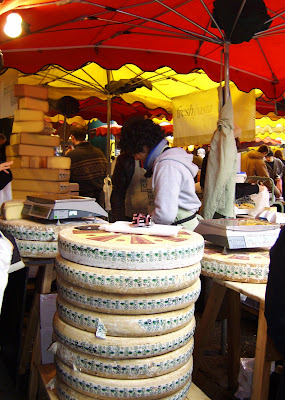
Visited Borough Market in Southwark, London last weekend. The medieval market was originally a wholesale fruit and vegetable outlet, and moved to its present site beneath the railway tracks in 1756. Now it sells gourmet foods from all over Britian and Europe.


Let them eat cake


Cheeses piled high.

I read recently that the more brightly coloured fruit and vegetables were full of antioxidents. This seems a good place to start shopping for your healthy diet.

Monday, February 26, 2007

Famous for fifteen minutes

Ah, the fleeting nature of fame!


Spotted this in Tower Bridge Road, London at the weekend. (I could have done without the American spelling of 'cancelled' - but perhaps I'm too fussy!)

Tuesday, February 20, 2007

Help - I've been tagged!


I’ve been tagged by Jonathan to choose my favourite French films. Help! I can’t really remember any, as I’m not really a film buff; I’m happy to watch a film once, and that’s that.


As for French films - well I remember the usual stuff, ‘Jean de Florette’, 'The Red Balloon ' etc.
However, one I particularly remember is ‘Blanche’ : this was directed by a Pole, Walerian Borowczyk, (1971) but I suppose it counts as it was filmed in French, in France.


It was an atmospheric tale set in a 13th century court, where the King’s young wife was seduced by the wrong man. The outcome was pretty savage; her lover being drawn behind horses until he was a ‘bleeding piece of earth’ and Blanche herself suffering the dreadful fate of being bricked up. So not what you’d call a jolly film!


But it was filmed beautifully; slowly, the camera allowed to linger. The period setting was meticulously realized, and the music, played on original instruments was authentic and moving. I like that fact that many foreign films are so static and unrushed, refusing to bow to the Hollywood requirement to dash about hither and thither at great head-spinning speed. After all, life is not a series of ‘edited highlights’.

I have no problem with subtitles - in fact if a film is dubbed, I won’t watch it. Dubbing drains all the atmosphere from a film; the sound of the language -whether you understand it or not - is essential to the ‘spirit of place‘
So - not a list I’m afraid, but the best I can do!

Spot the Dog


As though to prove its rural credentials, where other publications might run a ‘Spot the Ball’ competition (which for those unfamiliar with the idea is a photograph of a football game where the ball has been removed; the competitors have to gauge from the position and the demeanour of the players, where the ball is likely to be) our local newspaper, the Westmorland Gazette runs a weekly ‘Spot the Dog’ competition.

Here we have a rural scene of a sheepdog herding a flock of sheep - and yes, the dog has been removed from the photo.the competitors mark with a cross the place where they estimate the dog should be. It is actually quite good fun. A knowledge of the behaviour of sheep is an advantage.

This week's competition photo is at the top of this page; go on, have a go - spot the dog!


Here is the newspaper’s cartoonist Colin Shelbourn’s spin on the topic:

8 August 2003
Major national news: Britain has a hot summer.
Even the Lake District gets a bit hot.


Due to the weather,
this week's ‘Spot The Dog’ competition
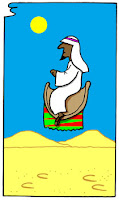
has been replaced with ‘Spot The Camel.’

Tuesday, February 06, 2007

A Cottage by the Sea


A Cottage by the Sea. 1. '3 The Hill'

Some time in the late 1940s my Grandfather bought a small cottage at the seaside. It was in a long, straggling, faded village called Allonby on the Solway coast. The village had been a popular bathing resort in the Victorian era and still had some elegant building, one known as The Baths, and a Reading Room donated by the local Quakers.

Charles Dickens and his friend Wilkie Collins visited the village in the1850s when they were touring, ostensibly researching for their joint story ‘The Lazy Tour of Two Idle Apprentices’ (which eventually appeared in 5 parts in Household Words in 1857)
Their characters arrive at the village
:


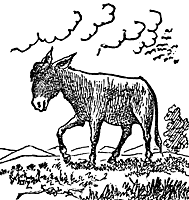
' 'A watering-place,' retorted Thomas Idle, with the pardonable sharpness of an invalid, 'can't be five gentlemen in straw hats, on a form on one side of a door, and four ladies in hats and falls, on a form on another side of a door, and three geese in a dirty little brook before them, and a boy's legs hanging over a bridge (with a boy's body I suppose on the other side of the parapet), and a donkey running away. What are you talking about?'

'Allonby, gentlemen,' said the most comfortable of landladies as she opened one door of the carriage;

'Allonby, gentlemen,' said the most attentive of landlords, as he opened the other. '


The cottage’s address was 3 The Hill - but if it was indeed a hill it must have been only 2 or 3 inches above the surrounding terrain. This was no picture-postcard 'second-home', more a ramshackle make-do-and-mend sort of place.

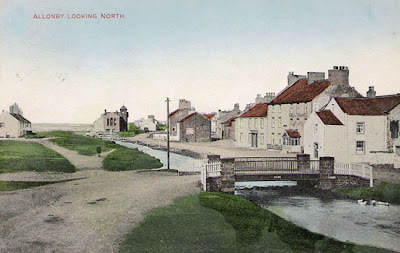
We were part of a higgledy-piggledy block of back-to-back houses in the middle of a grassy area only a matter of yards from the beach. (the small white block on the left at the top of the picture, between the beck and the beach) They were literally ‘back-to-back’ as number 3 had neither windows nor a door at the rear. We faced onto the green where the Beck ran the length of the village crossed by several white-painted bridges.
On the corner of the block was the Riding School (presided over by Lenny - the heart-throb of many a small girl) - a hanging-out spot for my sister and most of the other visiting children. (I was reluctant as I was afraid of horses!)


The layout of our little house was difficult; the second bedroom led off the first. The ‘bathroom’ had no bath, just a kitchen-style deep enamel sink together with a loo behind a partition. In a recess in the wall was a pile of ancient ‘Tit-Bits’ magazines (left behind by the previous owner) the like of which we had never seen before , and which we children found very amusing. The kitchen was no more than an under-stairs cupboard which had two electric rings on a shelf.
In spite of these limitations we happily spent many weekends, Easter fortnights and long, lazy summer holidays there for several years.

The Idle Apprentices again:

The brook crawled or stopped between the houses and the sea, and the donkey was always running away, and when he got into the brook he was pelted out with stones, which never hit him, and which always hit some of the children who were upside down on the public buildings, and made their lamentations louder. This donkey was the public excitement of Allonby, and was probably supported at the public expense. ‘

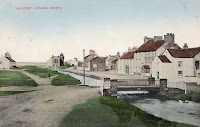
Old postcard. The Hill is on the far left


'There were fine sunsets at Allonby when the low flat beach, with its pools of water and its dry patches, changed into long bars of silver and gold in various states of burnishing, and there were fine views - on fine days - of the Scottish coast. But, when it rained at Allonby, Allonby thrown back upon its ragged self, became a kind of place which the donkey seemed to have found out, and to have his highly sagacious reasons for wishing to bolt from…’